Are Wider Tyres Always Better?
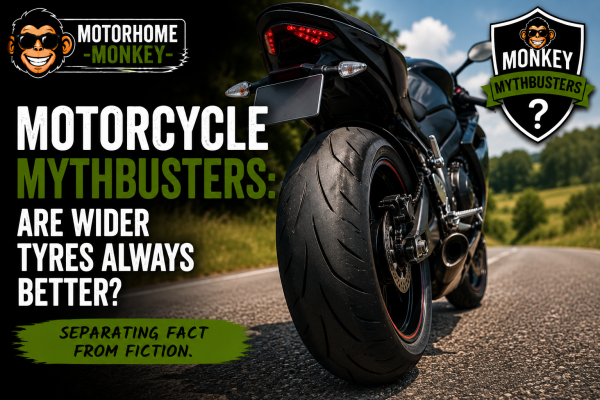
It’s a belief that’s almost as old as motorcycling itself: wider tyres mean more grip, better handling and a safer ride. But is fitting the widest tyre possible really an upgrade, or could it actually make your motorcycle handle worse? In this edition of Motorcycle Mythbusters, we separate fact from fiction.
The Myth
“The wider the tyre, the more grip your motorcycle will have.”
At first glance, it sounds logical.
A wider tyre appears to put more rubber on the road, so surely that must increase grip?
The reality is rather more complicated.
Why People Believe It
Many high-performance sports bikes have very wide rear tyres.
This leads to the assumption that width alone is responsible for their impressive grip levels.
Motorcycle manufacturers also use wider tyres on more powerful machines because they need to cope with greater acceleration and power output.
However, those tyres are designed as part of the motorcycle’s overall geometry—not simply to make it “grippier.”
What the Evidence Says
Grip depends on many factors, including:
- Tyre compound.
- Tyre construction.
- Tyre temperature.
- Correct tyre pressure.
- Suspension setup.
- Road surface.
- Rider input.
Tyre width is only one part of the equation.
Manufacturers spend thousands of hours developing motorcycles around a specific tyre size. Changing that size significantly can alter steering characteristics, stability and handling.
In many cases, fitting a tyre wider than recommended offers little or no real-world benefit.
Can Wider Tyres Make Handling Worse?
Yes.
A tyre that’s wider than the manufacturer intended may:
- Slow the steering.
- Increase the effort needed to turn.
- Alter the motorcycle’s handling characteristics.
- Affect lean behaviour.
- Change the tyre profile and contact patch.
On lightweight motorcycles such as the Honda Monkey or Honda Grom, fitting an oversized tyre can even make the bike feel less agile.
When Are Wider Tyres Beneficial?
There are situations where wider tyres are appropriate.
Motorcycles with higher power outputs often require wider rear tyres to transmit power effectively.
Adventure bikes, touring motorcycles and sports bikes all have tyre sizes chosen to suit their intended purpose.
The important point is that the tyre should match the motorcycle—not simply be as wide as possible.
Should You Stick to the Manufacturer’s Recommendation?
For most riders, yes.
The manufacturer’s recommended tyre size has been selected after extensive testing to provide the best balance of:
- Grip.
- Stability.
- Steering response.
- Comfort.
- Safety.
Unless you’re making a carefully considered modification with expert advice, sticking to the approved sizes is usually the best approach.
Are There Exceptions?
Some owners fit alternative tyre sizes for very specific reasons, such as availability, specialist riding or approved modifications.
However, these changes should always remain within the manufacturer’s permitted limits and should never compromise safety or legality.
🧠 Motorhome Monkey Myth Verdict
⚠️ PARTLY TRUE
Wider tyres can offer advantages on motorcycles designed to use them.
However, simply fitting a wider tyre to any motorcycle does not automatically increase grip and may actually reduce handling quality if it alters the bike’s intended geometry.
The best tyre is usually the one that matches the manufacturer’s specification and is suited to your riding conditions.
Motorhome Monkey Take
It’s easy to assume that bigger means better, but motorcycles are carefully engineered systems where every component works together.
Before changing tyre sizes, ask yourself whether you’re solving a real problem or simply changing the appearance of the bike.
In many cases, investing in high-quality tyres of the correct size will improve your riding far more than fitting wider rubber.
Did You Know?
Two tyres of exactly the same width can deliver very different levels of grip. Modern tyre compounds, carcass construction and tread design often have a far greater influence on real-world performance than width alone.