Should You Always Use the Front Brake More Than the Rear?
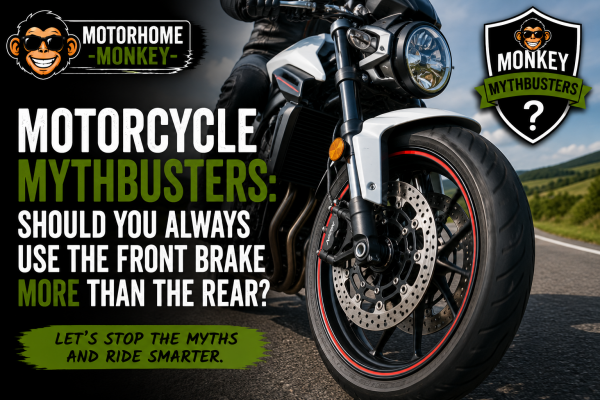

Ask ten motorcyclists how they brake, and you’ll probably get ten different answers. Some insist the front brake should do almost all the work, while others believe the rear brake is just as important. So, who’s right? In this edition of Motorcycle Mythbusters, we look at one of the most enduring debates in motorcycling.
The Myth
“You should always use the front brake and avoid using the rear brake.”
It’s advice that’s often given to new riders.
The reasoning is simple: the front brake provides most of a motorcycle’s stopping power, while the rear brake is supposedly easy to lock and therefore best avoided.
Like many motorcycle myths, there’s an element of truth—but it doesn’t tell the whole story.
Why People Believe It
When you brake, weight transfers forwards.
As the front suspension compresses, the front tyre gains grip while the rear tyre becomes lighter.
This allows the front brake to generate significantly more stopping force than the rear.
Because of this, many riders conclude that the rear brake serves little purpose.
What the Evidence Says
Motorcycle training and advanced riding techniques consistently teach riders to use both brakes together for normal controlled stops.
The front brake provides the majority of the stopping power, but the rear brake contributes stability and helps keep the motorcycle balanced.
Using both brakes smoothly also reduces stopping distances compared with relying on either brake alone.
Modern motorcycles equipped with ABS (Anti-lock Braking Systems) make effective use of both brakes while helping to prevent wheel lock under heavy braking.
When the Rear Brake Is Particularly Useful
The rear brake plays an important role in several situations, including:
- Slow-speed manoeuvres.
- U-turns.
- Filtering through traffic.
- Hill starts.
- Riding with a passenger.
- Maintaining stability on loose or uneven surfaces.
Many experienced riders use gentle rear brake input to improve control during low-speed riding.
Can You Stop Using Only the Front Brake?
Yes—but it’s rarely the best technique.
In an emergency, instinctively grabbing a handful of front brake can overwhelm the available grip, particularly on wet or loose surfaces.
Good braking is progressive.
Applying both brakes smoothly while increasing pressure as weight transfers forwards allows the motorcycle to slow quickly while remaining stable.
What About ABS?
ABS doesn’t remove the need for good braking technique.
It helps prevent the wheels locking during heavy braking, but riders should still practise smooth, progressive braking using both controls.
Think of ABS as a safety net—not a substitute for skill.
Are There Exceptions?
There are.
Very experienced riders may occasionally favour one brake over the other depending on the situation.
Likewise, some off-road techniques differ significantly from road riding.
For everyday road riding, however, using both brakes appropriately remains the widely accepted approach.
🧠 Motorhome Monkey Myth Verdict
⚠️ PARTLY TRUE
The front brake does provide most of a motorcycle’s stopping power.
However, that doesn’t mean the rear brake should be ignored.
Using both brakes together provides better control, greater stability and, in many situations, shorter stopping distances than relying solely on the front brake.
Motorhome Monkey Take
Rather than thinking of one brake as “the important one”, think of them as a team.
The front brake does most of the work, while the rear brake helps keep the motorcycle balanced and composed.
Learning to use both controls smoothly is one of the best riding skills you can develop, whether you’re riding a Honda Monkey through town or touring the Highlands on a larger motorcycle.
Like any skill, it improves with practice.
Did You Know?
During hard braking, up to around 70–90% of a motorcycle’s braking force can come from the front wheel, depending on the motorcycle, rider input and road conditions. That’s why smooth, progressive use of the front brake is so important—but it’s also why the rear brake still has an important supporting role in maintaining stability.