Should You Empty Your Motorhome Water Tanks Before Travelling?
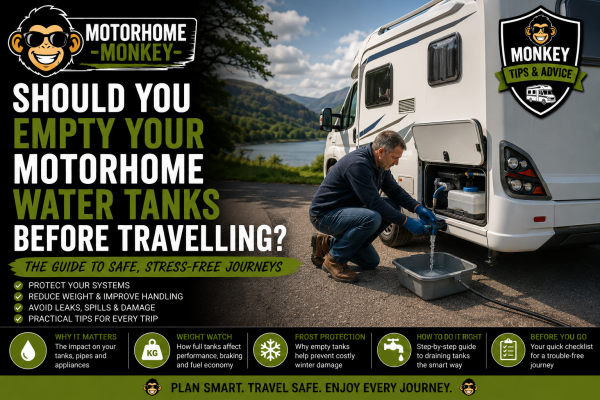
It’s one of those questions that divides opinion among motorhome owners. Some people never travel without a full fresh water tank, while others insist it should always be empty to save weight. So, should you empty your motorhome water tanks before travelling? The answer depends on where you’re going, how far you’re travelling and how much payload your motorhome has available.
Why This Question Matters
Water is surprisingly heavy.
Every litre of fresh water weighs approximately 1 kilogram.
That means:
- 20 litres = around 20kg
- 50 litres = around 50kg
- 100 litres = around 100kg
For many motorhomes, carrying a full water tank can significantly reduce your available payload.
If you’re already travelling with passengers, bikes, awnings, food and clothing, those extra kilograms can quickly add up.
Travelling with a Full Fresh Water Tank
There are certainly advantages.
A full or partially filled tank means you can:
- Stop for lunch without worrying about water.
- Wash your hands.
- Flush the toilet if required.
- Make drinks wherever you stop.
- Arrive at a campsite without immediately needing a water point.
If you’re travelling to a basic campsite or an overnight stop with limited facilities, carrying extra water makes perfect sense.
The Downsides
The obvious disadvantage is weight.
Extra weight can affect:
- Payload.
- Fuel consumption.
- Braking distances.
- Vehicle performance.
- Tyre loading.
While the effect on fuel economy may be relatively small, carrying unnecessary weight is never ideal.
There is also another consideration.
A nearly full tank is generally less prone to water sloshing than a half-full tank, but either way the extra weight still has to be carried by the vehicle.
What About the Waste Water Tank?
The answer here is much simpler.
Where possible, empty your grey waste water tank before setting off.
There’s little benefit in carrying used sink and shower water unless you have no practical alternative.
Travelling with a full waste tank simply adds unnecessary weight and reduces your available payload.
Many campsites provide dedicated waste disposal points, making it easy to empty before leaving.
Is It Safe to Travel with Water On Board?
Yes.
Motorhome manufacturers design fresh water tanks to be used while travelling.
Many owners routinely carry enough water for the day’s journey without any issues.
The key consideration isn’t safety—it’s weight.
How Much Water Should You Carry?
There’s no single right answer.
Many experienced motorhome owners adopt one of these approaches:
Short Journey to a Campsite
Carry only enough water for drinks, handwashing and toilet use.
Top up on arrival.
Wild Camping or Aires
Carry considerably more water, particularly if you’re unsure where the next refill point will be.
Winter Touring
Some owners travel with reduced water levels during freezing conditions to minimise the risk of frozen pipework, although preparation will depend on the weather and your motorhome’s winterisation.
Don’t Forget Your Payload
One of the most important figures in your motorhome handbook is the payload.
Remember that payload includes:
- Fresh water.
- Passengers.
- Dogs.
- Bikes.
- Food.
- Clothing.
- LPG.
- Accessories you’ve added.
- Everything else you carry.
It’s remarkably easy to exceed your legal weight without realising it.
If you’re unsure, consider visiting a public weighbridge before a longer trip.
Our Practical Approach
For most UK touring, many owners find that carrying around 20–30 litres of fresh water strikes a sensible balance.
It provides enough water for comfort during the journey while avoiding the unnecessary weight of travelling with a completely full tank.
Of course, every trip is different.
A weekend on a fully serviced campsite has very different requirements to a week exploring remote parts of Scotland.
Motorhome Monkey Verdict
So, should you empty your motorhome water tanks before travelling?
Not necessarily.
Fresh water is useful, and carrying a modest amount often makes journeys more convenient. However, travelling with a completely full tank when you don’t need it simply adds unnecessary weight and reduces your available payload.
As for the waste water tank, the advice is much clearer—empty it whenever you reasonably can before setting off.
Ultimately, the best approach is to carry only as much water as your journey requires, balancing convenience against payload and efficiency.
Motorhome Monkey Tip
Before every trip, ask yourself:
“Will I genuinely use this water before I reach my destination?”
If the answer is no, consider travelling with less and topping up when you arrive. Your motorhome—and your payload—will thank you for it.