Motorhome Weight Myths: Is It Safe to Exceed Your Payload?
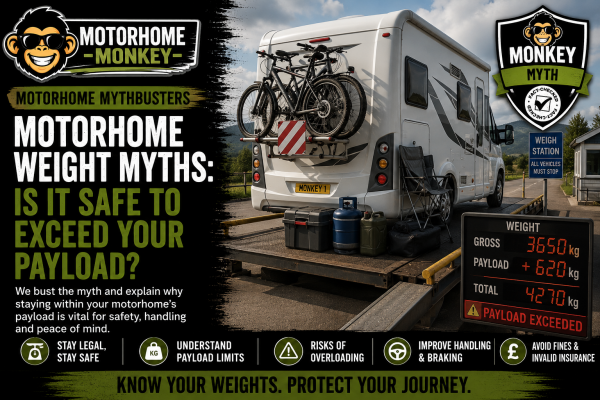
Motorhome weight myths can be costly—and not just financially. Exceeding your payload doesn’t simply affect handling; it can have legal, safety and insurance implications too. In this edition of Motorhome Mythbusters, we explore one of the most misunderstood aspects of motorhome ownership.
The Myth
“It’ll only be a few kilograms over the limit. That won’t make any difference.”
It’s a comment heard surprisingly often on campsites and online forums.
After all, if your motorhome weighs just a little over its maximum authorised weight, surely it isn’t a major problem?
Unfortunately, it isn’t that simple.
While a few extra kilograms might seem insignificant when you’re talking about a vehicle weighing three and a half tonnes, every kilogram counts. Exceeding your legal weight limit can affect braking distances, handling, tyre performance and even your insurance.
Let’s take a closer look.
Understanding Payload
Before we can bust the myth, it’s important to understand what payload actually means.
In simple terms, payload is the amount of weight you can legally add to your motorhome.
That includes almost everything you put inside the vehicle:
- Passengers
- Clothing
- Food
- Water
- Gas bottles
- Bicycles
- Camping furniture
- Awnings
- Pets
- Accessories you’ve fitted after purchase
Many first-time buyers are surprised to discover that optional extras fitted by the dealer can reduce the available payload before they’ve packed a single suitcase.
Bigger Doesn’t Always Mean More Payload
Another common misconception is that larger motorhomes automatically offer more carrying capacity.
In reality, the opposite can often be true.
Luxury features such as island beds, larger fridges, satellite systems, lithium batteries and solar installations all add weight.
It’s entirely possible for a large, well-equipped motorhome to have less usable payload than a smaller, simpler model.
This is one reason why checking the vehicle’s payload before buying is so important.
Why Weight Matters
Manufacturers don’t set weight limits arbitrarily.
Every component of your motorhome—from the chassis and suspension to the tyres and brakes—has been designed to operate safely within specified limits.
Overloading places additional strain on those components.
Braking distances can increase, tyres may run hotter, suspension performance may suffer and handling can become less predictable, particularly during emergency manoeuvres or strong crosswinds.
Even if the difference isn’t immediately noticeable behind the wheel, the extra stress is still there.
What About Insurance?
Many owners don’t realise that exceeding your motorhome’s legal weight could also create problems with insurance.
If you’re involved in an accident and investigations reveal the vehicle was overloaded, your insurer may take that into account when assessing a claim.
Equally, police and enforcement officers have the power to stop and weigh motorhomes.
If your vehicle exceeds its legal limit, you could be required to remove weight before continuing your journey.
That’s not the way anyone wants to start a holiday.
How to Avoid Overloading
Fortunately, avoiding the problem isn’t difficult.
The simplest solution is to visit a public weighbridge.
Many local authorities and commercial operators provide weighing facilities for a small fee, allowing you to see exactly how much your motorhome weighs when loaded for a typical trip.
You may be surprised by the results.
Travelling with only the amount of fresh water you actually need, reviewing unnecessary equipment and distributing heavy items sensibly can all make a significant difference.
Don’t Forget the Axle Limits
It’s also worth remembering that your motorhome has individual front and rear axle limits as well as an overall weight limit.
Even if the total weight is legal, loading too much weight behind the rear axle—perhaps with electric bikes on a rack or heavy equipment in the garage—can overload one axle while the vehicle remains within its overall limit.
That’s another reason why careful packing matters.
Myth Verdict
❌ MYTH BUSTED
Being “only a little bit overweight” doesn’t make overloading acceptable.
Motorhome weight limits exist to protect your safety, improve vehicle handling and ensure your motorhome performs as its manufacturer intended.
Knowing your payload, packing carefully and occasionally visiting a weighbridge are simple habits that can help you travel more safely and with greater peace of mind.
When it comes to motorhome weights, guessing is never as good as knowing.