Why Does My Motorhome Toilet Smell? Causes and Simple Fixes
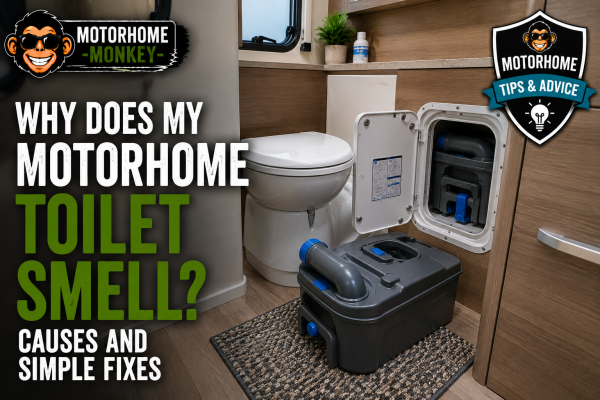
Motorhome toilet smells are unpleasant, but the cause is usually straightforward to identify. From an overdue cassette clean to worn seals or poor ventilation, this guide explains what to check and how to deal with persistent toilet odours safely.
A motorhome toilet should not normally leave a persistent unpleasant smell inside the vehicle. If your motorhome toilet smells, the problem is usually connected with the waste-holding tank, seals, ventilation or the way the toilet is being cleaned and maintained.
The good news is that you do not necessarily need a complicated repair. In many cases, emptying and cleaning the cassette properly, checking the seals and making sure the ventilation system is working can make a noticeable difference.
However, it is important not to treat a cassette toilet exactly like the toilet in your house. Motorhome toilets use plastic tanks, rubber seals and, depending on the system, specific ventilation arrangements. Some common household cleaning products can damage these components.
Here’s how to work out where the smell is coming from and what you can do about it.
Why does my motorhome toilet smell?
There are several possible causes, and more than one can exist at the same time.
The most common include:
- Waste and deposits building up inside the cassette
- A worn or dirty cassette seal
- Problems with the cassette’s venting system
- The toilet being left too long between emptying
- Residue or scale around the toilet bowl and blade valve
- Incorrect or unsuitable cleaning products
- A damaged component or poor seal allowing odours to escape
Thetford identifies deposits inside the waste-holding tank and worn lip seals among the common causes of unpleasant smells. It also recommends regular emptying, cleaning and seal maintenance.
The first step is therefore to establish where the smell seems strongest.
If it is coming from the toilet bowl, start by checking the bowl, blade valve and seal.
If the smell is strongest around the cassette compartment or outside access hatch, concentrate on the cassette, its seals and ventilation.
If the smell remains after the cassette has been thoroughly cleaned, it is worth investigating the ventilation system and the condition of the seals.
Start with the cassette
If your motorhome has a cassette toilet, the removable waste-holding tank is the obvious place to start.
Even when the cassette has been emptied regularly, deposits can accumulate inside it. Limescale, urine scale, grease and other residue can remain on the tank walls and internal components. Over time, these deposits can contribute to persistent odours.
Simply emptying the cassette does not necessarily remove this build-up.
After emptying it, rinse the tank thoroughly with clean water. If it has not had a proper deep clean for some time, use a tank-cleaning product specifically intended for your type of cassette toilet and follow its instructions.
Thetford recommends periodic deep cleaning because deposits can build up inside the waste-holding tank even when toilet additives are being used. Dometic also provides dedicated tank-cleaning products for removing deposits from waste-holding tanks.
Don’t wait until the cassette is completely full
Emptying frequency depends on the toilet system, additive being used, weather and how heavily the motorhome is occupied.
As a general principle, do not wait until the cassette is completely full if it has already started to smell.
Thetford’s current guidance recommends emptying regularly and notes that warm weather and frequent use can accelerate the build-up that contributes to odours.
Always follow the instructions for your particular toilet and waste-treatment product rather than assuming one emptying interval applies to every system.
Check the cassette seal
A rubber seal helps keep the waste tank closed and prevents odours escaping from the cassette.
If that seal becomes dirty, dry, cracked or worn, it may no longer perform properly.
Remove the cassette and inspect the seal carefully. Look for:
- Dirt or residue around the sealing surface
- Cracks or visible damage
- Signs that the rubber has become hard or brittle
- A seal that looks distorted or does not sit correctly
Cleaning the seal is an important part of cassette maintenance. Depending on the toilet manufacturer, a suitable seal lubricant may also be recommended.
For example, Thetford recommends keeping the rubber lip seal clean and lubricated, while Dometic’s cassette toilet instructions similarly recommend regular cleaning and lubrication of seals. The exact lubricant and procedure can vary, so check the instructions for your toilet before applying anything.
If the seal is damaged or has reached the end of its useful life, cleaning it will not solve the problem. It may need replacing.
Check the blade valve
The blade valve separates the toilet bowl from the waste cassette when it is closed.
If residue has collected around the valve or its seal, unpleasant smells can find their way back into the toilet bowl.
With the cassette removed and following your toilet manufacturer’s instructions, inspect the valve area for obvious deposits or damage.
Do not force the mechanism or dismantle components unless you are confident that the procedure is suitable for your particular toilet.
A valve that is difficult to operate, does not close properly or allows liquid to pass when it should be closed may need attention beyond simple cleaning.
Don’t overlook ventilation
Ventilation is an important part of controlling smells from a cassette toilet.
The cassette contains waste and gases, so the system needs to manage those odours rather than simply allowing them to accumulate inside the motorhome.
Some cassette toilets have external vents or optional powered ventilation systems designed to direct odours outside the vehicle. Thetford, for example, offers venting systems that extract odours from the waste tank to the outside.
If your toilet normally relies on ventilation and suddenly starts smelling, check whether:
- The external vent is obstructed
- A ventilation filter needs attention or replacement
- A powered fan is actually operating
- The cassette is correctly positioned
- Any seals or connections around the cassette compartment are damaged
Do not block or remove a ventilation arrangement simply because it appears to be the source of the smell. The correct solution is to identify why it is not working as intended.
Are you using the right toilet chemicals?
This is an area where more is definitely not better.
It can be tempting to reach for bleach, disinfectant, limescale remover or another strong household toilet cleaner when a motorhome toilet smells.
That can be a mistake.
Cassette toilets contain plastic components and rubber seals that may not be compatible with conventional household toilet chemicals. Thetford specifically warns against bleach-based cleaners, vinegar and limescale removers for its cassette toilets because they can damage plastic, seals and internal components.
Dometic similarly advises against cleaning agents containing chlorine or alcohol for its CT4000 cassette toilets, as well as abrasive and soda-based cleaners.
The important point is not that one particular brand of toilet chemical is universally correct. It is that you should use products that are specified as suitable for your particular toilet system and follow the manufacturer’s instructions.
That is especially important if your toilet is an older model, because recommendations and materials can vary between systems.
What about ordinary household toilet cleaner?
For the same reason, avoid assuming that a normal household toilet cleaner is suitable simply because it works well at home.
Your motorhome toilet may look similar to a domestic toilet, but the waste system is quite different.
The safest approach is to check the toilet manufacturer’s cleaning instructions. If they specify a particular type of cleaner, use that rather than experimenting with strong household chemicals.
Thetford’s guidance explicitly states that household cleaners can damage seals and other toilet components, while Dometic specifies mild cleaning agents for its cassette toilet systems.
Give the cassette a proper deep clean
If the toilet has developed a persistent smell, a thorough clean is often more useful than simply adding more deodorising fluid.
Start by completely emptying the cassette at an appropriate waste disposal point.
Then:
- Rinse the cassette thoroughly with clean water.
- Clean the outside and accessible components according to the manufacturer’s instructions.
- Pay particular attention to the valve, seals and areas where residue can accumulate.
- Use a suitable cassette or tank-cleaning product if the manufacturer recommends one.
- Rinse thoroughly afterwards.
- Inspect the seals and moving parts.
- Lubricate seals where appropriate using the recommended product.
- Refit the cassette correctly and check that it is seated securely.
A periodic deep clean is particularly worthwhile if the toilet has developed a smell that regular emptying and normal cleaning no longer controls.
Thetford currently recommends deep cleaning its waste-holding tanks two to three times a year, while the exact maintenance schedule should always be matched to the toilet manufacturer’s instructions.
What if the toilet still smells after cleaning?
If you’ve cleaned the cassette, checked the seals and confirmed that the ventilation system is working, but the smell remains, don’t simply keep adding more chemicals.
Try to identify exactly where the odour is coming from.
Smell strongest inside the bathroom
Check the:
- Toilet bowl
- Blade valve
- Bowl seal
- Cassette seal
- Toilet ventilation arrangements
A persistent smell from the bowl can indicate that the valve or seal is not isolating the waste tank properly.
Smell strongest around the cassette compartment
Check the cassette seating, seals, venting and access hatch.
A damaged seal or poorly seated cassette can allow smells to escape into the compartment.
Smell appears mainly when driving
This can point towards the cassette, ventilation or sealing arrangements rather than simply the cleanliness of the toilet bowl.
Check that the cassette is properly fitted and that its seals and venting arrangements are in good condition.
Smell is strongest outside the motorhome
Some odour outside the vehicle can be expected, particularly during emptying or when the waste system is being vented.
However, a sudden or unusually strong smell may justify checking the ventilation system and cassette for deposits, damage or other problems.
A simple routine to prevent motorhome toilet smells
Preventing the problem is generally easier than trying to remove a smell that has been allowed to build up.
A sensible routine includes:
- Empty the cassette regularly.
- Rinse it thoroughly after emptying.
- Use an appropriate waste-treatment product according to its instructions.
- Keep the toilet bowl and blade area clean.
- Inspect the cassette seal regularly.
- Lubricate seals using the product recommended for your toilet.
- Deep-clean the waste tank periodically.
- Keep ventilation arrangements clear and working.
- Follow the manufacturer’s cleaning instructions.
- Avoid unsuitable household chemicals.
Thetford’s current maintenance guidance similarly recommends regular emptying, rinsing, appropriate waste additives, seal lubrication and periodic deep cleaning.
Don’t confuse toilet smells with other motorhome smells
If you’ve cleaned the toilet thoroughly and the smell remains, consider whether the source is actually the toilet.
Motorhomes contain several other systems that can produce unpleasant smells, including the grey water system, sink waste and shower waste.
A smell coming from a plughole may therefore have nothing to do with the cassette toilet.
If the odour changes when you run water into the sink or shower, investigate the waste-water system as well.
This is one reason why simply pouring stronger toilet chemicals into the cassette may fail to solve the problem.
When should you replace a seal?
Rubber seals are wear components, so they will eventually need replacing.
There is no universal replacement interval that applies to every motorhome toilet. Usage, cleaning practices, storage and the particular toilet design all affect how long a seal lasts.
Thetford, for example, states that the replacement interval for its lip seal depends on user behaviour and recommends replacement after four to six years for certain cassette systems. That should not be treated as a universal rule for every toilet.
If a seal is visibly damaged, cracked, permanently distorted or no longer sealing correctly, replacement is more important than trying to extend its life with additional lubricant.
Use the correct replacement part for your toilet model.
When is professional help needed?
Most routine cassette-toilet maintenance is straightforward, but there are occasions when professional assistance makes sense.
Consider getting help if:
- The cassette is leaking.
- The valve will not close properly.
- A replacement seal does not solve the problem.
- The toilet is damaged.
- The ventilation system has an electrical fault.
- You cannot identify the source of a persistent smell.
- Waste is escaping somewhere it should not.
Don’t ignore a persistent smell simply because the toilet still appears to work.
An odour can be an early indication of a seal, ventilation or waste-system problem, and identifying the cause is usually easier before a small fault becomes a larger one.
Conclusion
If your motorhome toilet smells, don’t assume that you simply need more deodoriser.
Start with the basics: empty and rinse the cassette, inspect the seals and valve, clean away accumulated deposits and make sure the ventilation system is working properly.
Just as importantly, avoid treating the toilet like a domestic bathroom. Manufacturer guidance for cassette toilets specifically warns against unsuitable household cleaners because they can damage seals and other components.
A little regular maintenance goes a long way. Keeping the cassette clean, the seals in good condition and the ventilation working properly should help keep unpleasant odours under control — and make one of the less glamorous jobs of motorhome ownership considerably more manageable.