Why Is My Motorhome Leisure Battery Not Charging?
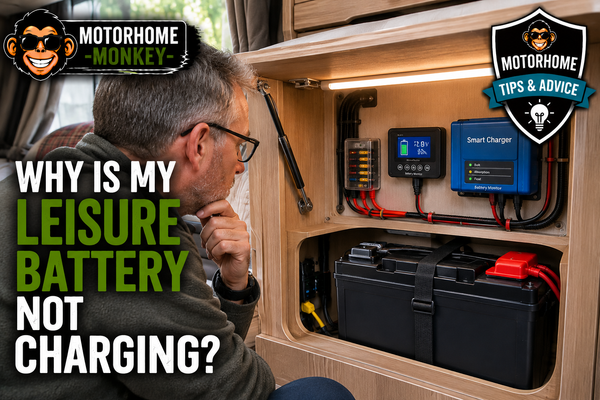
Is your motorhome leisure battery not charging properly? Whether you’re connected to mains hook-up, driving or relying on solar power, there are several possible causes. This practical troubleshooting guide explains what to check, how to identify common faults and when it’s time to call in a specialist.
Few things are more frustrating than discovering that your motorhome leisure battery isn’t charging, particularly when you’re preparing for a trip or relying on it while staying away from an electric hook-up.
If your motorhome leisure battery is not charging, the problem could be something relatively simple, such as a switched-off charger, a blown fuse or a solar panel that isn’t receiving enough sunlight. Alternatively, there could be a problem with the onboard charger, alternator charging system, battery management system or the battery itself.
The first thing to establish is how you’re trying to charge it.
Most motorhomes have three main ways of charging the leisure battery:
- Mains hook-up: An onboard battery charger uses the campsite’s electrical supply.
- While driving: The vehicle’s alternator supplies charging power, usually through a relay or battery-to-battery charger.
- Solar power: Solar panels feed electricity through a solar charge controller to the battery.
Each system has different components, so identifying which charging method isn’t working is the best starting point.
The good news is that there are several straightforward checks you can make before assuming the battery needs replacing.
First, establish whether the leisure battery is actually charging
Before investigating individual components, check what your motorhome’s electrical system is telling you.
Most motorhomes have a control panel or battery monitor displaying information about the leisure battery.
Depending on the system, this might include:
- Battery voltage
- Estimated state of charge
- Charging status
- Current entering or leaving the battery
- Mains hook-up status
- Solar charging information
However, not all displays provide the same information.
A simple voltage display, for example, doesn’t necessarily tell you whether the battery is receiving a meaningful charging current.
If your motorhome has a battery monitor showing charging current, check whether it indicates that electricity is actually entering the battery.
Don’t rely entirely on the battery voltage display
Battery voltage can be misleading if you don’t understand what you’re looking at.
When a charger is operating, the displayed voltage may rise because the battery is receiving a charging supply. This doesn’t automatically mean the battery is fully charged.
Similarly, voltage can temporarily fall when electrical equipment is switched on.
If possible, check the manufacturer’s instructions for your battery monitor and understand what its readings represent.
A battery that appears to have a reasonable voltage may still have reduced capacity or an internal fault.
It’s also important to remember that lithium batteries have different charging characteristics from conventional lead-acid batteries. Some battery management systems can also prevent charging under certain conditions.
If the readings don’t make sense, avoid assuming that the battery itself is faulty.
1. Motorhome leisure battery not charging on mains hook-up
If your leisure battery isn’t charging when connected to a campsite electric hook-up, start by checking the mains supply and the onboard battery charger.
When connected to a suitable 230V supply, most motorhomes use an onboard charger or power supply unit to provide charging power to the leisure battery.
The arrangement varies between manufacturers and models, but the general principle is the same.
Check that the electric hook-up is working
It sounds obvious, but first establish whether electricity is actually reaching your motorhome.
Check:
- Is the campsite hook-up switched on?
- Is your motorhome’s mains connection secure?
- Is the electrical lead visibly damaged?
- Has the campsite supply tripped?
- Has the motorhome’s RCD or circuit breaker operated?
If other 230V appliances are working normally, that suggests the mains supply is reaching the vehicle, although it doesn’t prove that the battery charger is working.
The Camping and Caravanning Club recommends checking the electrical supply and ensuring that hook-up equipment is maintained in good condition. It also highlights the importance of RCD and MCB protection.
Check whether the onboard charger is switched on
Some motorhomes have a separate battery charger switch or settings within the electrical control panel.
Check your handbook to establish whether the charger needs to be enabled.
Also look for any charging indicators on the control panel or battery monitor.
If the motorhome has a combined power supply unit, the battery charger may be incorporated into that system.
Check the relevant fuses
A blown fuse can interrupt the charging supply between the charger and leisure battery.
Some motorhomes have separate fuses protecting the battery charging circuit.
Your owner’s handbook should identify the relevant fuse locations and ratings.
If you find a blown fuse, don’t simply replace it repeatedly. A replacement fuse that blows again could indicate an underlying electrical fault.
Only replace accessible fuses if you can identify the correct component and rating. Never bypass a fuse or fit one with a higher rating.
The onboard charger could be faulty
If the mains supply is working, the charger is switched on and the relevant fuses appear intact, the onboard charger could be the problem.
Possible faults include:
- Internal charger failure
- Incorrect charging settings
- A damaged connection
- A faulty battery temperature sensor, where fitted
- An incompatibility between the charger and battery type
This last point is particularly important if you’ve recently changed your leisure battery.
For example, a lithium battery generally requires a charging system with a suitable lithium charging profile. A charger designed for a conventional lead-acid battery may not be appropriate.
Check the battery and charger manufacturers’ instructions to confirm compatibility.
If the charger needs testing or electrical components need removing, arrange for a qualified motorhome technician to investigate.
2. Motorhome leisure battery not charging while driving
If the leisure battery charges when connected to mains electricity but doesn’t appear to charge while driving, the problem is likely to involve the alternator charging system.
When the engine is running, the vehicle’s alternator produces electricity.
In many motorhomes, this electricity is also used to charge the leisure battery.
However, the system used to transfer power depends on the motorhome’s electrical design.
Older vehicles may use a split-charge relay, while newer installations can use a battery-to-battery charger, sometimes called a DC-DC charger.
What is a split-charge relay?
A split-charge relay allows the leisure battery to receive charging power from the alternator when the engine is running.
When the engine is switched off, the relay separates the starter and leisure battery circuits to prevent the habitation equipment from unnecessarily draining the starter battery.
If the relay fails or its associated wiring develops a fault, the leisure battery may no longer receive a charge while driving.
Possible symptoms include:
- The leisure battery voltage doesn’t rise while the engine is running.
- The battery monitor shows no alternator charging current.
- The leisure battery gradually loses charge despite regular driving.
The relay itself may be faulty, but damaged wiring, connections or fuses can produce similar symptoms.
Could the battery-to-battery charger be faulty?
Many modern motorhomes use a battery-to-battery charger rather than a traditional split-charge relay.
These chargers regulate the electricity supplied from the vehicle’s alternator to the leisure battery.
They are particularly useful in vehicles with modern smart alternators, where the alternator voltage can vary according to the vehicle’s operating conditions.
If the battery-to-battery charger isn’t working, the leisure battery may receive little or no charging power while driving.
Some chargers have status lights or displays that indicate whether they are operating normally.
Check the manufacturer’s instructions for the meaning of any warning lights or fault codes.
Could it be a smart alternator issue?
Modern vehicles increasingly use smart alternators to improve fuel efficiency and manage electrical demand.
Unlike older charging systems, the alternator voltage can vary depending on driving conditions and the vehicle’s electrical requirements.
This can affect leisure battery charging.
Some motorhomes require a suitable battery-to-battery charger to ensure the leisure battery receives the correct charging supply.
If your motorhome has recently developed charging problems following a battery replacement or electrical modification, check that the charging equipment is compatible with the vehicle.
Don’t assume that replacing a relay or fitting a different charger will automatically solve the problem.
The system needs to be suitable for the vehicle, alternator and leisure battery.
3. Motorhome leisure battery not charging from solar panels
Solar charging is particularly useful when staying away from mains electricity.
However, if your leisure battery isn’t charging from solar power, several things could be responsible.
The system generally consists of:
- One or more solar panels
- Solar panel wiring
- A solar charge controller
- Connections between the controller and battery
- Associated fuses and isolators, where fitted
A problem with any of these components can interrupt the charging process.
Check the solar panel is receiving sunlight
This is the simplest thing to investigate.
Solar panels produce less electricity when sunlight is reduced.
Factors affecting solar output include:
- Cloudy weather
- Low winter sunshine
- Shadows from trees or buildings
- Dirt or debris on the panels
- The position and angle of the panels
During winter, solar charging can be considerably reduced compared with the summer months.
This doesn’t necessarily mean something is faulty.
If the motorhome has been parked under trees or beside a building, try moving it into a more open position if practical.
Check the solar charge controller
The solar charge controller regulates the electricity produced by the panels before it reaches the leisure battery.
Without a suitable controller, the battery could be exposed to an inappropriate charging voltage.
Most motorhome solar installations use either a PWM or MPPT controller.
An MPPT controller can generally extract more usable power from a solar panel, particularly in varying conditions.
If your controller has a display, check for:
- Solar panel input
- Battery voltage
- Charging current
- Warning lights
- Fault messages
If the controller indicates that the solar panels are producing power but the battery isn’t receiving a charge, the problem could be with the controller, its settings, wiring or battery connection.
Check whether the solar system has been isolated
Some motorhomes have an isolator switch between the solar panels, controller and battery.
If the system has been switched off, the battery won’t receive solar charging.
Check the handbook to identify any solar isolator switches and their correct positions.
Also check whether the battery isolator or habitation system has been switched off.
Don’t change wiring connections or disconnect solar panels while the system is energised unless the manufacturer’s instructions specifically permit it.
Could the solar panels be faulty?
Solar panels are generally reliable, but damage can occur.
Possible problems include:
- Damaged panel wiring
- Loose electrical connections
- Water ingress
- Physical damage to the panel
- Faulty connectors
- A failed charge controller
If the controller shows no solar input despite good daylight conditions, there may be a problem with the panel or its wiring.
A qualified technician can test the solar installation and identify where the charging supply is being interrupted.
4. The leisure battery charges but quickly goes flat
Sometimes the problem isn’t actually that the battery isn’t charging.
It may be charging correctly but losing its stored electricity unusually quickly.
This is a different problem and needs a slightly different approach.
Possible causes include:
- An ageing leisure battery
- Reduced battery capacity
- A battery that has been repeatedly discharged too deeply
- Excessive electrical consumption
- An appliance remaining switched on
- A faulty battery management system
- An electrical fault causing an unwanted discharge
How old is your leisure battery?
Leisure batteries don’t last forever.
Their useful lifespan depends on the battery type, quality, charging arrangements, usage and maintenance.
Lead-acid batteries can suffer damage if repeatedly discharged too deeply or left in a discharged condition.
Lithium batteries have different characteristics and often offer a longer service life, but they still have limits and require suitable charging equipment.
If your battery is several years old and has gradually lost its ability to hold charge, it may simply be approaching the end of its useful life.
However, age alone doesn’t prove that the battery needs replacing.
Are you using more electricity than you realise?
Modern motorhomes can have several electrical consumers operating even when you aren’t actively using them.
These can include:
- Security alarms
- Gas detectors
- Refrigerators
- Heating controls
- Standby electronics
- USB charging equipment
- Routers and other accessories
Some appliances consume electricity continuously.
The Camping and Caravanning Club explains that modern motorhomes can continue drawing small amounts of electricity even when apparently switched off, which is why leisure batteries need regular maintenance charging during storage.
If your battery is losing charge unexpectedly, investigate what is consuming electricity before assuming the battery is faulty.
5. Could the battery type or settings be the problem?
This is particularly important if you’ve recently replaced your leisure battery.
Different battery technologies have different charging requirements.
The main types commonly found in motorhomes include:
Flooded lead-acid batteries
These are conventional batteries containing liquid electrolyte. Some require periodic maintenance, including checking electrolyte levels where the design permits.
AGM batteries
Absorbent Glass Mat batteries are a type of sealed lead-acid battery. They have different charging characteristics from conventional flooded batteries.
Gel batteries
These are another type of sealed lead-acid battery using gelled electrolyte. They require an appropriate charging profile.
Lithium batteries
Most modern motorhome lithium leisure batteries use lithium iron phosphate (LiFePO4) technology.
They have different charging requirements and normally incorporate a battery management system (BMS) to protect the battery.
Check that your charger matches your battery
A charger that isn’t configured for the correct battery chemistry may fail to charge the battery properly or could potentially damage it.
For example, a charger set to an unsuitable lead-acid profile may not correctly charge a lithium battery.
Similarly, not every charger designed for one type of lead-acid battery is suitable for every other type.
If you’ve upgraded your leisure battery, check:
- Is the onboard charger compatible?
- Is the battery-to-battery charger compatible?
- Is the solar controller configured correctly?
- Does the battery manufacturer specify any temperature restrictions?
- Are the battery management system requirements being met?
Don’t assume that simply connecting a new battery to the existing charging equipment will produce the correct result.
If you’re unsure, ask the battery manufacturer or a qualified motorhome electrical specialist to check the complete charging arrangement.
6. What can you safely check yourself?
There are several useful checks that don’t require dismantling electrical equipment.
Before investigating, make sure the motorhome is safely parked and follow the manufacturer’s instructions.
Here is a simple checklist.
Basic visual checks
- Check that the leisure battery is securely positioned.
- Look for obvious damage to accessible wiring.
- Check that battery connections appear secure, without touching or disconnecting them.
- Look for signs of corrosion around accessible terminals.
- Check whether the relevant battery isolator is switched on.
- Look for warning lights on the electrical control panel.
- Check the solar controller display, if fitted.
- Check the motorhome handbook for charger and battery information.
If you are competent and have the correct equipment, you may also be able to measure battery voltage using a suitable multimeter.
However, voltage measurements need interpreting correctly. A reading taken while charging, immediately after charging or while electrical equipment is operating may not represent the battery’s resting condition.
Never allow a tool or metal object to bridge the battery terminals.
A simple charging test
If your motorhome has a battery monitor that displays charging current, it can help you establish whether each charging method is operating.
You can compare the readings under different conditions:
- Check the battery monitor with the motorhome disconnected from mains electricity.
- Connect a suitable mains hook-up and allow the charging system to operate.
- Check whether the monitor indicates charging.
- If safe and practical, disconnect the mains supply and check the readings with the engine running.
- Check the solar charging display in daylight, following the system manufacturer’s instructions.
You are looking for evidence that the charging system is delivering power to the leisure battery.
Remember that some systems have time delays, temperature restrictions or charging controls that affect their behaviour.
If you don’t have a suitable battery monitor, don’t assume that a basic voltage reading will tell you everything.
7. When should you stop investigating and call a specialist?
Although some charging problems are relatively straightforward, others involve electrical components that should only be inspected by someone qualified.
You should seek professional help if:
- The battery becomes unusually hot.
- The battery casing is swollen, cracked or leaking.
- You notice a strong or unusual smell around the battery.
- There is evidence of melted wiring or burnt connections.
- Fuses repeatedly blow.
- The onboard charger makes unusual noises or produces a burning smell.
- The battery management system reports a serious fault.
- The mains electrical installation appears damaged.
- You cannot identify the cause of the charging problem.
If a battery is swollen, leaking or overheating, stop using and charging it if you can do so safely. Keep away from damaged battery components and arrange professional assistance.
Lead-acid batteries can release hydrogen during charging, which is flammable and potentially explosive. Damaged battery installations therefore need particular care.
Never disconnect battery terminals or investigate exposed 230V electrical components while the system is energised.
The Camping and Caravanning Club recommends that detailed electrical safety and installation problems are referred to a qualified technician or Approved Workshop.
It is much better to have a charging fault properly diagnosed than to risk damaging the battery or creating a more serious electrical problem.
8. How to prevent leisure battery charging problems
A little preventative maintenance can help avoid many common charging problems.
It is worth making battery care part of your normal motorhome maintenance routine.
Keep the battery charged
Don’t leave a leisure battery discharged for extended periods. Follow the manufacturer’s recommendations for charging and storage.
Check the charging system periodically
If possible, check that mains, alternator and solar charging are all operating correctly.
Keep connections in good condition
Have accessible battery connections inspected for corrosion, looseness or damage.
Use the correct charger
Make sure your charging equipment is compatible with the battery chemistry and capacity.
Avoid excessive discharge
Understand how much electricity your motorhome uses and avoid repeatedly running the battery too low.
Pay attention during winter storage
Cold weather, reduced solar output and long periods without use can all affect battery condition.
If your motorhome is stored for several weeks or months, make suitable arrangements to maintain the leisure battery in accordance with its manufacturer’s instructions.
A suitable smart charger or correctly configured onboard charging system can help maintain the battery during periods of inactivity.
Conclusion
If your motorhome leisure battery isn’t charging, don’t immediately assume that the battery needs replacing.
Start by identifying which charging method isn’t working.
If the problem occurs on mains hook-up, investigate the onboard charger and electrical supply.
If the battery isn’t charging while driving, the alternator charging system, split-charge relay or battery-to-battery charger could be responsible.
If solar charging isn’t working, check the solar controller, isolators and the amount of sunlight reaching the panels.
And remember that a battery which charges but quickly goes flat may have a completely different problem from one that isn’t charging at all.
A few sensible checks can help narrow down the cause, but leave electrical repairs and potentially dangerous battery faults to a suitably qualified specialist.
Looking after your leisure battery is an important part of motorhome ownership. A properly maintained charging system means fewer surprises, more reliable onboard electricity and, hopefully, fewer interruptions to your next trip.