What Driving Licence Do You Need to Drive a Motorhome in the UK?
Not every motorhome can be driven on a standard car licence. The licence you need depends mainly on the vehicle’s Maximum Authorised Mass (MAM), your age and when you passed your driving test. Here’s how to check whether you’re entitled to drive the motorhome you’re considering buying.
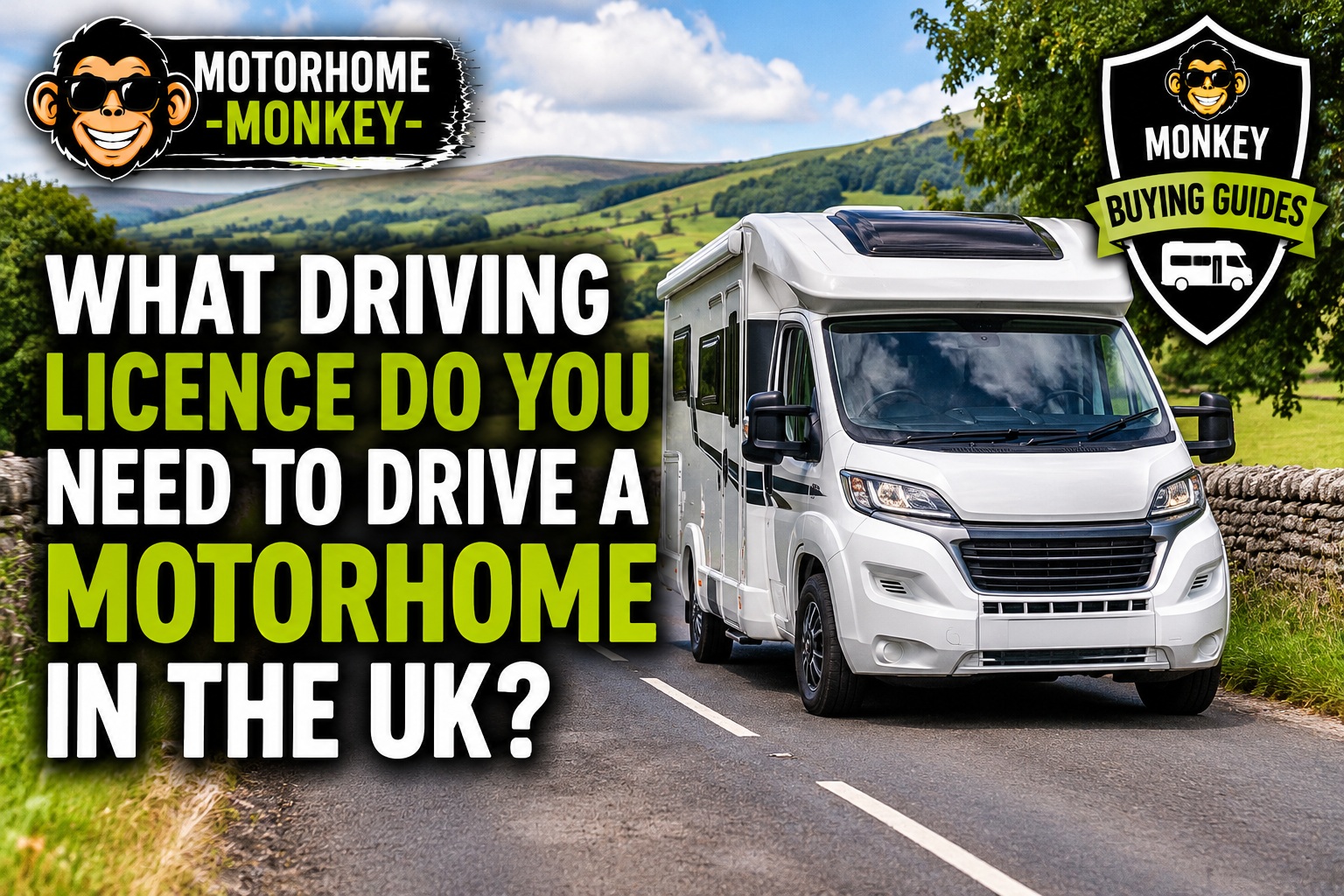
Before buying a motorhome, it’s worth checking that your driving licence allows you to drive it. While many motorhomes can be driven on an ordinary car licence, larger and heavier models may require additional entitlement.
The rules are based mainly on the vehicle’s Maximum Authorised Mass (MAM) – the maximum permitted weight of the motorhome when fully loaded. The date you passed your driving test also matters, particularly if you passed before 1 January 1997.
Understanding the difference between Category B, C1 and C licences can help you avoid an expensive mistake when choosing your next motorhome.
Understanding motorhome weights
The most important figure when checking your motorhome driving licence is its Maximum Authorised Mass, usually abbreviated to MAM.
MAM is the maximum permitted weight of the vehicle when loaded. It includes the motorhome itself, fuel, water, passengers, luggage, equipment and everything else being carried.
You may also see this figure referred to as the Gross Vehicle Weight (GVW) or Maximum Technically Permissible Laden Mass (MTPLM), depending on the manufacturer’s documentation.
It is important not to confuse MAM with the vehicle’s unladen or empty weight. A motorhome might weigh considerably less when empty, but its licence category is determined by its maximum authorised weight. For a closer look at the weight allowance you have available for passengers and equipment, read our guide to motorhome payload.
For example, if a motorhome has a MAM of 4,250kg, you need the appropriate entitlement for a vehicle in that weight category, even if it currently weighs only 3,700kg.
Which motorhome can you drive on a Category B licence?
A Category B licence is the standard full car driving licence.
If you passed your car driving test on or after 1 January 1997, your Category B entitlement normally allows you to drive a motorhome with a MAM of up to 3,500kg.
This covers a large proportion of the motorhomes available in the UK, including many coachbuilt motorhomes, campervans and van conversions.
However, some larger motorhomes have a MAM above 3,500kg. These cannot be driven on a standard Category B entitlement unless you hold an additional entitlement that allows it.
There is a separate allowance for certain zero-emission vehicles, but the ordinary 3,500kg limit remains the relevant threshold for conventional diesel and petrol motorhomes.
If you’re considering a motorhome close to the 3,500kg limit, remember that the figure includes the maximum permitted payload. You cannot simply drive a heavier vehicle because you intend to carry less equipment.
What is a Category C1 driving licence?
A Category C1 licence allows you to drive vehicles with a MAM of more than 3,500kg and up to 7,500kg.
This is particularly relevant when looking at larger motorhomes, including some A-class models and vehicles with more substantial storage, payload or equipment.
The basic categories are:
| Licence category | Motorhome weight |
|---|---|
Category B | Up to 3,500kg |
Category C1 | Over 3,500kg up to 7,500kg |
Category C | Over 7,500kg |
Category C1 also allows a trailer with a MAM of up to 750kg. If you want to tow a heavier trailer, additional entitlement may be required, such as C1E.
If you passed your car test after 1 January 1997 and do not already hold C1 entitlement, you will normally need to apply for provisional C1 entitlement, meet the medical requirements and pass the relevant tests.
For anyone considering a heavier motorhome, obtaining C1 entitlement can open up a wider choice of vehicles.
What is a Category C licence?
If you want to drive a motorhome with a MAM of more than 7,500kg, you will need Category C entitlement.
Category C is commonly associated with larger goods vehicles, but it also covers motorhomes above the 7.5-tonne threshold.
These vehicles are less common in the UK motorhome market, but you may encounter them when looking at particularly large or specialist touring vehicles.
A Category C licence allows you to drive vehicles over 3,500kg, with a trailer of up to 750kg MAM. A heavier trailer requires the appropriate additional entitlement, such as C+E.
Category C has more demanding medical and licensing requirements than a standard car licence.
Passed your driving test before 1 January 1997? You may already have C1 entitlement
This is where things become particularly interesting for older drivers.
If you passed your car driving test before 1 January 1997, you may have been granted additional driving entitlements automatically. These are often referred to as grandfather rights.
In many cases, this includes Category C1, allowing you to drive vehicles with a MAM of between 3,500kg and 7,500kg without taking a separate C1 driving test.
Your licence may also show Category C1E, sometimes with restriction code 107, which relates to the permitted combined weight of the vehicle and trailer.
However, it is important not to assume that everyone who passed before 1997 has exactly the same entitlements. Older licence categories and restrictions can vary depending on when your licence was issued.
The best approach is to check the categories actually shown on your driving record.
There is also an important age-related consideration: the additional C1 entitlement granted through pre-1997 car test rights normally expires when your licence reaches its 70th birthday renewal point, unless you apply to retain it and meet the relevant medical requirements.
If you are considering a motorhome over 3,500kg, check this well before buying. The precise entitlement shown on your licence is what matters; pre-1997 entitlements and restrictions can vary.
What happens to your C1 entitlement when you reach 70?
For many motorhome owners, reaching 70 is an important point to consider, particularly if they drive a vehicle weighing more than 3,500kg.
A standard Category B car licence can be renewed at 70 and then every three years. There is no automatic upper age limit for driving, provided you continue to meet the relevant medical and licensing requirements.
However, C1 entitlement has additional requirements.
If you obtained C1 automatically through passing your car test before 1 January 1997, that entitlement does not simply continue indefinitely when you reach 70. You must apply to retain it and meet the higher medical standards applicable to C1 drivers.
This normally involves submitting the relevant DVLA application and a medical examination report, known as form D4.
If you already hold C1 because you passed a separate C1 driving test, different renewal arrangements apply. C1 is subject to Group 2 medical standards, with medical examinations required at age 45 and at subsequent five-year renewals until age 65. From age 65, renewal and medical examinations are required annually.
The rules can be confusing because pre-1997 C1 entitlement and C1 entitlement obtained through a separate test have different histories.
If you are approaching 70, check the renewal instructions sent by DVLA and make sure you understand what is needed to retain your particular entitlement.
Do you need a medical examination to drive a heavier motorhome?
Medical requirements depend on the licence category and how you obtained it.
A standard Category B car licence does not normally require a routine medical examination simply because you reach a particular age. Drivers must still notify DVLA of medical conditions that could affect their ability to drive safely.
Category C1 and C licences are subject to higher medical standards.
For a driver applying for C1 entitlement through the normal testing route, a medical examination is required as part of the application process. Further medical examinations are required as the driver gets older:
- Under 45: Medical requirements apply when first obtaining the entitlement, with renewal arrangements depending on the licence.
- Age 45 onwards: Medical examinations are required at five-year intervals.
- Age 65 onwards: Medical examinations are required annually.
The medical examination is recorded on form D4. A doctor completes the medical assessment, and an optometrist or optician can complete the eyesight section if necessary.
If you retain C1 entitlement beyond 70, you must renew it separately from your ordinary car licence and meet the relevant medical standards. C1 renewal is by post, and the DVLA renewal process requires a D4 medical report when applicable.
These requirements are not intended to prevent older people from enjoying motorhoming. They are there to ensure that drivers remain medically fit to control heavier vehicles safely.
How to check what your driving licence allows you to drive
You should never rely solely on the date you passed your driving test or what somebody tells you about your entitlement.
The easiest way to check is through the official GOV.UK driving licence service. These rules describe Great Britain; licensing arrangements can differ in Northern Ireland, so check with the Driver and Vehicle Agency (DVA) if you live there.
You can use it to view the categories you are entitled to drive, their validity dates and any restrictions.
Check your driving licence here:
View your driving licence on GOV.UK.
Look for the following categories:
- B: Standard cars and motorhomes up to 3,500kg MAM.
- C1: Vehicles between 3,500kg and 7,500kg MAM.
- C: Vehicles over 3,500kg; for motorhomes above 7,500kg, Category C is required (C1 covers motorhomes up to 7,500kg).
- C1E: C1 vehicles with heavier trailers, subject to the relevant combined weight restrictions.
Pay attention to the valid-from and valid-to dates shown against each category, along with any restriction codes.
If you are unsure what an older category or restriction means, use the GOV.UK guide to comparing old and new driving licence categories.
Check your licence before buying a motorhome
One of the easiest mistakes to make when buying a motorhome is concentrating on its layout, engine, equipment and appearance without checking whether you are legally entitled to drive it.
This is particularly important if you are considering a larger model.
Before committing to a purchase, work through these checks. You may also find our guide to choosing the right motorhome size useful.
- Find the motorhome’s MAM. Ask the dealer or seller for the manufacturer’s weight information. Do not rely on its empty weight.
- Check your driving licence. Confirm whether you hold Category B, C1 or C entitlement.
- Check the dates and restrictions. Make sure the relevant category is still valid and that you understand any restriction codes.
- Consider your age. If you are approaching 70 and rely on pre-1997 C1 entitlement, establish what you need to do to retain it.
- Check the payload. Make sure the motorhome has sufficient allowance for passengers, luggage, water and equipment.
- Confirm before paying a deposit. If anything is unclear, contact DVLA or seek clarification from the dealer before completing the purchase.
A motorhome that looks perfect on paper may not be the right choice if your licence does not cover its weight.
Final thoughts
Choosing a motorhome is about finding the right balance between size, layout, comfort and practicality. But before getting carried away with the extras and specifications, make sure your driving licence covers the vehicle you want.
For many owners, a standard Category B licence is perfectly adequate. Others may already have C1 entitlement because they passed their car test before 1 January 1997, while drivers looking at heavier motorhomes may need to obtain additional qualifications.
The important thing is to check rather than assume. A quick look at your driving record before buying could save a great deal of inconvenience later.
Get the licence right first, and then you can concentrate on finding the motorhome that’s right for you.