Motorhome Payload Explained: How Much Payload Do You Really Need?
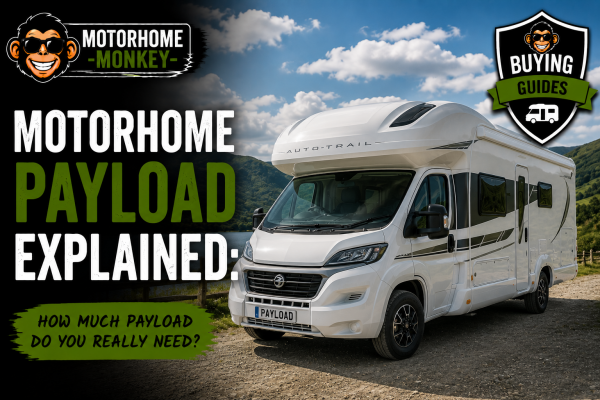
A motorhome may have six berths, a spacious garage and plenty of storage cupboards—but can it legally carry everything you want to take? Payload is one of the most misunderstood aspects of motorhome ownership, yet it’s one of the most important. Understanding it before you buy could save you from an expensive mistake and help keep you safe and legal on the road.
What Is Payload?
Put simply, payload is the amount of weight you can add to a motorhome before it reaches its legal maximum weight.
That includes almost everything you put into the vehicle after it leaves the factory, including:
- People
- Clothing
- Food
- Water
- Gas bottles
- Bicycles
- Camping furniture
- Dogs
- Accessories fitted after manufacture
It’s surprisingly easy to use up your available payload without realising it.
Understanding the Key Terms
When researching motorhomes, you’ll come across several important weight definitions.
MTPLM (Maximum Technically Permissible Laden Mass)
This is the maximum legal weight of the fully loaded motorhome.
You must never exceed it.
MRO (Mass in Running Order)
This is the motorhome’s weight as supplied by the manufacturer, typically including standard equipment and essential fluids. However, the exact definition can vary slightly between manufacturers, so always check what is included in the published figure.
Payload
Payload is simply:
MTPLM − MRO = Available Payload
This is the weight you have left for passengers, luggage and accessories.
Why Payload Matters
Imagine buying a beautiful six-berth motorhome with a payload of only 350kg.
Now add:
- Two adults
- Two children
- Full water tank
- Bikes
- Awning
- Camping chairs
- Clothing
- Food
- Dog
You may already be approaching—or exceeding—the legal limit.
Being overloaded isn’t just illegal; it can affect braking, handling and tyre performance, and may have insurance implications.
What Uses Up Payload?
Many buyers are surprised by how quickly payload disappears.
Typical additions include:
| Item | Approximate Weight* |
|---|---|
| Adult passenger | 70–90 kg |
| Child | 30–50 kg |
| Full fresh water tank (100L) | ~100 kg |
| Leisure battery | 25–30 kg |
| Gas bottle (steel, full) | 20–30 kg |
| Electric bike | 20–30 kg each |
| Bike rack | 10–20 kg |
| Awning | 25–40 kg |
| Camping table and chairs | 15–25 kg |
Weights are approximate and vary by product and individual circumstances.
Don’t Forget Factory Options
One common misunderstanding is assuming the brochure payload still applies after optional extras have been fitted.
Items such as:
- Automatic gearbox
- Solar panels
- Satellite dish
- Air conditioning
- Larger engine
- Extra batteries
- Towbar
all add weight and reduce your remaining payload.
Always ask the dealer for the payload of the actual vehicle you’re buying—not just the brochure figure.
Can You Increase Payload?
In some cases, yes.
Certain motorhomes can be uprated to a higher maximum authorised mass, provided the chassis and running gear are suitable.
However, this may:
- Require suspension or tyre upgrades.
- Affect driving licence requirements.
- Change road tax or speed limits in some countries.
Always seek professional advice before uprating.
Weigh Your Motorhome
The only reliable way to know whether your motorhome is within its legal limit is to weigh it.
Ideally, weigh it:
- Ready for a trip.
- With passengers.
- With full fuel.
- With your usual luggage.
- With bikes or accessories fitted.
A public weighbridge provides peace of mind and can highlight any problems before you set off.
Common Buying Mistakes
Avoid these common pitfalls:
- Assuming a larger motorhome always has more payload.
- Ignoring the weight of optional extras.
- Forgetting the weight of passengers.
- Travelling with full water tanks unnecessarily.
- Never checking the loaded weight on a weighbridge.
🐵 Motorhome Monkey Recommendation
A lower payload may be suitable if…
- You tour mainly as a couple.
- You travel light.
- You take shorter trips.
- You don’t carry bikes or bulky equipment.
Choose a higher payload if…
- You travel as a family.
- You carry electric bikes.
- You enjoy extended European tours.
- You regularly take outdoor equipment.
- You want flexibility without constantly worrying about weight.
When in doubt, it’s usually better to have more payload than you think you’ll need.
Motorhome Monkey Verdict
Payload isn’t the most exciting part of buying a motorhome—but it may be one of the most important.
A spacious interior and attractive layout count for little if you can’t legally carry the people and equipment you need for your travels.
Before buying, look beyond the upholstery and gadgets. Ask one simple question:
“How much payload does this particular motorhome have once all its optional extras have been fitted?”
That answer could make the difference between a motorhome that perfectly suits your adventures and one that’s frustratingly limited from day one.
Related Reading
You may also find these Motorhome Monkey guides helpful:
- What Size Motorhome Do You Really Need?
- Coachbuilt vs A-Class vs Campervan: Which Motorhome Is Right for You?
- How to Choose the Right Motorhome Layout for Your Travels
- Thinking of Buying a Motorhome? Which One Should You Buy?
- Motorhome Base Vehicle Reviews
Motorhome Monkey Tip
If you’re buying a used motorhome with accessories such as a bike rack, solar panels or a towbar already fitted, ask for a recent weighbridge certificate if one is available. It’s one of the quickest ways to understand how much real-world payload you’ll have left before loading up for your first adventure.