How to Store a Honda Monkey 125 Over Winter: A Practical Guide
Putting your Honda Monkey 125 away for winter? A little preparation helps protect it while it is unused. Here’s how to clean the bike, care for the chain and battery, protect the tyres and choose suitable storage, following Honda’s own guidance.
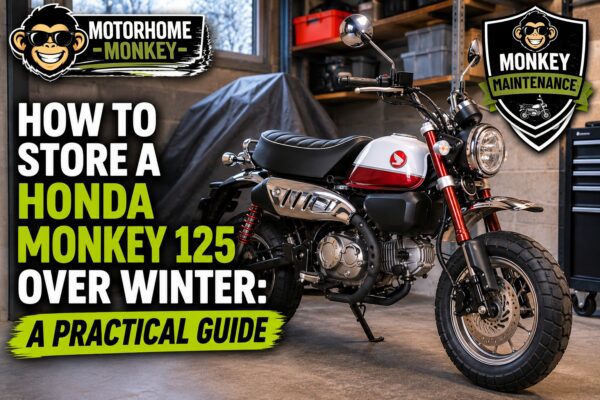
Putting your Honda Monkey 125 away for winter? A little preparation helps protect it while it is unused. Here’s how to clean the bike, care for the chain and battery, protect the tyres and choose suitable storage, following Honda’s own guidance.
How to Store a Honda Monkey 125 Over Winter: A Practical Guide
If your Honda Monkey 125 is going to spend several months off the road, prepare it before you put it away. Honda’s own owner’s manuals give a clear set of storage steps: wash and protect the motorcycle, lubricate the drive chain, keep both tyres off the ground where possible, and remove and store the battery correctly. These simple jobs help reduce avoidable deterioration while the bike is unused.
This guide follows the storage instructions in the 2019 and 2021 Monkey 125 manuals, alongside Honda UK’s general winter-care advice. Details can vary by model year, so always use the handbook supplied with your motorcycle if it differs.
1. Give the bike a thorough clean
Start by removing dirt, road grime and any salt residue. Honda warns that road salt and other salts used to prevent ice can promote corrosion, so pay particular attention if you have ridden on treated roads or near the coast. Clean the wheels, underside, swingarm and other areas where grime can collect.
Allow the engine, exhaust, brakes and other hot parts to cool before washing. Honda’s cleaning instructions recommend rinsing with a low-pressure garden hose, using a soft sponge or towel with a mild cleaner where needed, then rinsing thoroughly and drying with a soft, clean cloth. Avoid directing water into the air cleaner, muffler or electrical parts.
Once the motorcycle is dry, Honda recommends waxing painted surfaces to help protect them. Do not wax matte-painted panels, as this can change their appearance. The Monkey’s manual also advises coating chrome pieces with rust-inhibiting oil. Keep wax, oil and other products away from the tyres and braking surfaces.
2. Clean and lubricate the drive chain
Give the chain attention before storage rather than leaving road dirt and moisture sitting on it for months. Check its condition and slack in accordance with the maintenance section of your Monkey’s handbook. Look for stiff links, damaged rollers, loose pins or kinks; Honda advises having the chain inspected by a dealer if you find these problems.
Honda’s chain-cleaning procedure is specific: use a dry cloth with a high flash-point solvent and a soft brush if the chain is dirty. Wipe it dry, then lubricate it with Pro Honda HP Chain Lube or an equivalent lubricant. Do not use petrol or low flash-point solvents. They create a fire or explosion risk.
Take care not to get lubricant on the tyres or brakes, and do not apply so much that it is thrown around the motorcycle. If you wash the bike immediately beforehand, Honda says to lubricate the chain after washing and drying.
3. Protect the battery
Battery care is one of the most important parts of storing a motorcycle for several months. Honda’s Monkey 125 owner’s manuals recommend removing the battery to help prevent discharge, fully charging it, then keeping it in a shaded, well-ventilated place.
If you decide to leave the battery fitted, Honda gives an alternative: disconnect the negative (–) terminal to help prevent discharge. Follow the battery removal and installation procedure in your own model-year handbook. If you are unsure how to disconnect or remove it safely, ask a Honda dealer or competent motorcycle technician.
A suitable battery maintainer may be useful during a long lay-up, but do not assume every charger is appropriate. Check the battery type and specification fitted to your motorcycle, and use only a charger whose manufacturer confirms compatibility. Follow its connection and ventilation instructions. Honda’s storage instructions do not specify a particular charger or require a permanently connected maintainer.
For more background on maintaining a motorcycle battery, see our OptiMate 4 battery charger review.
4. Protect the tyres
Before the bike is stored, inspect both tyres for cuts, cracks, bulges, embedded objects and unusual wear. Check the pressures when the tyres are cold and use the figures specified in your Monkey’s owner’s manual. There is no need to guess at a higher storage pressure or over-inflate them.
Honda’s Monkey 125 storage guidance recommends placing the motorcycle on a maintenance stand and positioning a block so that both tyres are clear of the ground. This reduces the load on the tyres while the motorcycle is stationary.
Only attempt this if you have a stand designed for the Monkey and can support the motorcycle securely on a firm, level surface. The bike must not be left unstable or liable to fall. If you do not have suitable equipment or are unsure how to lift it safely, leave it on its tyres and ask a dealer for advice rather than improvising with unsuitable supports.
5. Choose a dry storage place and a suitable cover
A secure, dry garage or shed is a sensible place to keep the Monkey over winter. It protects the motorcycle from the worst of the weather and reduces the amount of moisture and dirt it is exposed to. Make sure the bike is clean and completely dry before covering it.
If the motorcycle has to be stored outside, Honda recommends considering a full-body motorcycle cover. Choose a cover intended for motorcycle use and follow its care instructions. A cover should protect the bike without leaving it damp underneath.
Honda makes one point particularly clear: after rain, remove the body cover and allow the motorcycle to dry. Do not leave a wet Monkey sealed under its cover. Check it periodically during the storage period, especially after prolonged wet weather.
6. What about fuel and other maintenance?
Be cautious about applying generic winter-storage advice to the Monkey’s fuel system. Honda’s storage section in the 2019 and 2021 manuals covers cleaning, chain lubrication, lifting the tyres, the cover and battery storage. It does not set out a specific instruction there to drain the tank, fill it completely or add a fuel stabiliser.
For that reason, do not automatically follow advice written for a different motorcycle or an older machine with a different fuel system. Check the handbook for your exact model year or ask a Honda dealer if you need advice about fuel during an extended lay-up.
It is also worth checking the service schedule before storage. If routine maintenance is due, plan it in accordance with the handbook rather than assuming that winter storage changes the service intervals. Our guide to the Honda Monkey service schedule explains the routine maintenance items.
7. Bringing your Honda Monkey back into use
When the riding season returns, do not simply uncover the bike and set off. Remove any support blocks and stands carefully, refit the battery if you removed it, and check that it is correctly connected and secure. Inspect the motorcycle all over before starting the engine.
At a minimum, check:
- Tyre condition and cold pressures.
- Drive-chain condition, slack and lubrication.
- Brake operation and visible condition of the braking components.
- Headlight, tail light, indicators, horn and brake light.
- Fluid levels and any signs of leaks.
- Controls, fasteners and general condition.
- That the battery is charged and securely installed.
Use the maintenance schedule in your own handbook and deal with any defects before riding. For a fuller set of checks before your first ride, read Honda Monkey Spring Maintenance: Simple Checks Before Riding. That article focuses on preparing the bike for the road, while this guide covers putting it away properly.
Common Honda Monkey winter storage mistakes
- Putting it away dirty or wet: grime and salt can encourage corrosion while the bike is unused.
- Leaving the chain neglected: clean and lubricate it before storage, following Honda’s procedure.
- Forgetting the battery: follow Honda’s removal and storage advice, or disconnect the negative terminal if it remains fitted.
- Leaving a cover on a wet motorcycle: Honda says to remove the cover after rain and allow the bike to dry.
- Improvising a support stand: use only suitable, stable equipment if lifting the tyres clear of the ground.
- Guessing at fuel treatment: check the handbook for your model year instead of assuming generic advice applies.
The bottom line
Storing a Honda Monkey 125 over winter does not need to involve a complicated list of jobs. Honda’s own guidance is straightforward: clean and dry the motorcycle, protect its finishes, lubricate the chain, look after the battery, support the tyres safely where possible and make sure the bike can dry after rain.
Use the owner’s manual supplied with your motorcycle as the final reference, particularly for battery removal and any model-year differences. A little preparation before the Monkey goes away makes it easier to look after during the winter and gives you a better starting point when you are ready to ride again.