TESA AutoLift Review: The Electromechanical Alternative to Hydraulic Levelling
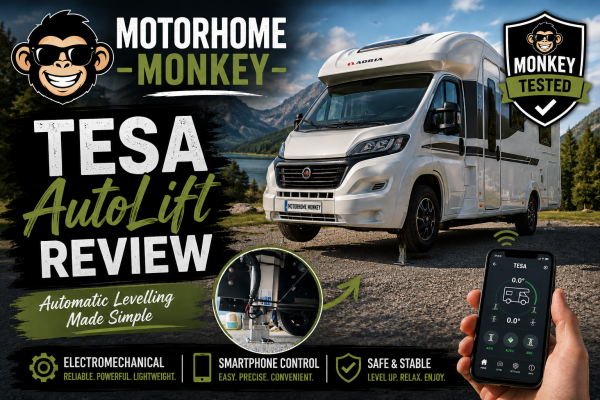
This TESA AutoLift review examines one of the most innovative levelling systems currently available for motorhomes. Unlike traditional hydraulic systems, TESA uses electromechanical technology to level and stabilise your motorhome at the touch of a button.
TESA AutoLift Review: Is This the Future of Motorhome Levelling?
Every motorhome owner has experienced it.
You arrive at a campsite after a long drive, select what appears to be the perfect pitch, switch off the engine and step inside—only to discover the floor slopes noticeably towards one corner.
The next few minutes are usually spent searching for levelling ramps, guiding the vehicle backwards and forwards, checking spirit levels and repeating the process until everything feels about right.
It’s a routine that most motorhomers simply accept as part of touring life.
But what if you could arrive on site, press a button and let technology do all the work?
That’s exactly what the TESA AutoLift system is designed to do.
What Is TESA AutoLift?
TESA AutoLift is a fully automatic levelling and stabilisation system developed specifically for motorhomes.
What makes it particularly interesting is the technology behind it.
Unlike many competing systems, TESA does not rely on hydraulic jacks or modifications to the vehicle’s air suspension.
Instead, it uses a sophisticated electromechanical system powered by electric motors and precision mechanical actuators.
The result is a levelling solution that automatically lifts and levels the motorhome without the complexity of hydraulic pumps, oil reservoirs, hoses or compressors.
For many owners, that’s one of the system’s biggest attractions.
How Does It Work?
The process is refreshingly simple.
Once parked, the driver activates the AutoLift system using the control panel.
Sensors assess the vehicle’s position and determine exactly how much adjustment is required.
The electromechanical legs are then deployed automatically, lifting and levelling the motorhome until it reaches the desired position.
The entire operation typically takes only a few minutes.
There’s no need to climb in and out of the cab, no guesswork and no levelling ramps to carry or store.
For owners who regularly move between campsites or aires, that’s a significant convenience.
Why Levelling Matters More Than You Think
Many people assume levelling is purely about comfort.
Certainly, nobody enjoys sleeping at an angle or feeling like they’re rolling out of bed during the night.
However, the benefits extend much further.
A level motorhome allows refrigerators to operate more efficiently, ensures shower trays drain correctly and helps cupboards and doors stay where they’re supposed to.
It also creates a more stable and comfortable living environment overall.
When you’ve invested heavily in a motorhome, small improvements to everyday comfort can have a surprisingly large impact on the touring experience.
Stability on Site
One aspect often highlighted by owners of automatic levelling systems is the increase in stability.
Traditional suspension systems naturally allow a degree of movement when people walk around inside the vehicle.
The TESA AutoLift system helps reduce this movement by providing additional support through its levelling legs.
The difference can be particularly noticeable in larger coachbuilt motorhomes and A-class vehicles.
When someone gets up during the night or moves around inside, the vehicle feels considerably more solid.
Advantages of the Electromechanical Design
The most obvious advantage of the TESA system is its avoidance of hydraulic technology.
Hydraulic systems have served motorhome owners well for many years, but they inevitably involve pumps, hoses, valves and hydraulic fluid.
TESA’s electromechanical approach eliminates many of these components.
This potentially reduces maintenance requirements and removes concerns about hydraulic oil leaks.
It also creates a cleaner, simpler engineering solution.
For technically minded owners, this may be one of the strongest arguments in favour of the system.
Are There Any Drawbacks?
No product is perfect.
The biggest obstacle for many buyers will be cost.
Automatic levelling systems represent a significant investment and are generally viewed as premium upgrades rather than essential equipment.
Weight must also be considered. Although the electromechanical design avoids heavy hydraulic equipment, any levelling system will add weight to the vehicle and affect available payload.
Potential buyers should always check specifications for their individual motorhome.
Who Is It Best Suited To?
The TESA AutoLift system is likely to appeal most to owners who spend significant time touring.
If you regularly move between campsites, stopovers and aires, the convenience quickly becomes apparent.
It’s also particularly attractive for larger motorhomes where levelling with ramps can be more challenging.
For occasional weekend users, the cost may be harder to justify.
For full-time or frequent travellers, however, the benefits may become part of everyday motorhome life.
Verdict
This TESA AutoLift Review highlights a product that offers a genuinely different approach to motorhome levelling.
Rather than relying on hydraulic or pneumatic technology, TESA has developed an elegant electromechanical solution that delivers automatic levelling and improved on-site stability with the press of a button.
Is it a necessity?
No.
Motorhome owners have managed perfectly well with levelling ramps for decades.
Is it one of those upgrades that could transform the way you use your motorhome?
Quite possibly.
For anyone seeking greater convenience, comfort and a touch of luxury on every pitch, the TESA AutoLift system is certainly worth serious consideration.
It may not be cheap, but it certainly makes arriving on site feel a little more luxurious.