Do Loud Exhausts Really Save Lives?
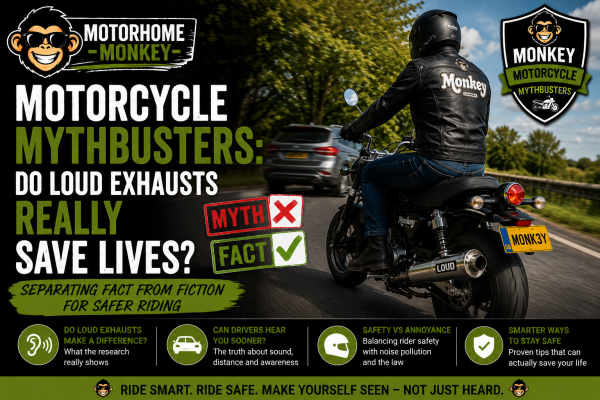
“Loud pipes save lives” is probably one of the best-known sayings in motorcycling. Many riders believe a noisy exhaust makes them more visible to other road users and therefore reduces the likelihood of being involved in a collision. But is there any evidence to support this belief, or is it simply one of motorcycling’s longest-running myths?
The Myth
“The louder your motorcycle exhaust, the safer you’ll be because drivers will hear you coming.”
It’s a phrase that’s been repeated for decades and is often used to justify fitting aftermarket exhaust systems.
At first glance, it seems logical.
If drivers can hear you, surely they’ll know you’re there.
The reality, however, is rather more complicated.
Why People Believe It
Motorcyclists are naturally vulnerable.
Unlike car drivers, they have no protective bodywork around them, so anything that increases their visibility is often viewed positively.
Many riders have experienced occasions where a pedestrian or another driver appeared to notice them after hearing the motorcycle.
These experiences reinforce the belief that louder equals safer.
What Does the Research Say?
Studies examining motorcycle conspicuity generally suggest that being seen plays a far greater role in avoiding collisions than being heard.
Modern cars are exceptionally well insulated from outside noise. Closed windows, soundproofing, music systems and air conditioning all reduce the amount of engine or exhaust noise reaching the driver.
In addition, most motorcycle exhaust noise is projected rearwards.
That means the driver you’re approaching from behind may hear very little until you’re already alongside them.
In many common accident scenarios—such as a vehicle pulling out from a side road—the driver is much more likely to see your headlight than hear your exhaust.
Visibility Matters More
If your aim is to reduce risk, there are several measures supported by road safety advice that are likely to have a greater impact than fitting a louder exhaust.
These include:
- Wearing bright or high-visibility riding gear where appropriate.
- Maintaining an effective road position.
- Using your headlights correctly.
- Anticipating hazards.
- Managing your speed.
- Making positive observations at junctions.
Good riding technique remains your greatest safety tool.
Are Aftermarket Exhausts a Bad Thing?
Not necessarily.
Many riders choose aftermarket exhausts because they:
- Reduce weight.
- Improve appearance.
- Produce a sound they enjoy.
- Enhance the riding experience.
There’s nothing inherently wrong with wanting a different exhaust note, provided the exhaust complies with legal requirements and doesn’t create unnecessary nuisance.
The important point is not to confuse personal preference with proven safety benefits.
Could a Driver Hear You?
Sometimes, yes.
At lower speeds, in slow-moving traffic or when riding alongside another vehicle, a louder motorcycle may be more noticeable.
However, that’s very different from saying it will consistently prevent collisions.
Safety depends on many factors, and relying on noise alone would be a mistake.
Myth Verdict
⚠️ PARTLY TRUE
A louder exhaust may make your motorcycle more noticeable in some situations, particularly at lower speeds or in close proximity to other vehicles.
However, there is no strong evidence that simply fitting a louder exhaust significantly reduces collision risk.
The most effective way to stay safe remains good observation, defensive riding, appropriate road positioning and making yourself as visible as possible.
Motorhome Monkey Take
There’s nothing wrong with enjoying the distinctive sound of a motorcycle, and many riders fit aftermarket exhausts for entirely legitimate reasons.
Just don’t assume that a louder exhaust is a substitute for good riding.
Ride as though other road users haven’t seen you, maintain plenty of space around your motorcycle and use your skills—not your exhaust—as your primary safety system.
That’s far more likely to bring you home safely after every ride.
Did You Know?
Many motorcycle collisions occur because drivers looked but failed to see the motorcycle—a phenomenon known as “Looked But Failed to See” (LBFTS). This is one reason why rider positioning, anticipation and conspicuity continue to be emphasised in advanced rider training.