Motorhome Solar Panel Myths: Do Solar Panels Really Need Sunshine?
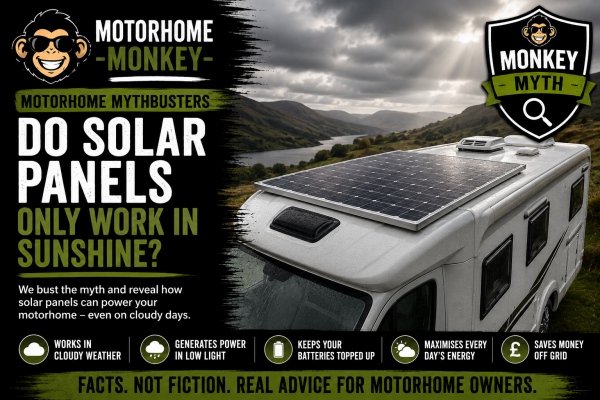
Motorhome solar panel myths often put owners off installing solar power. Discover whether solar panels really need direct sunshine and learn how they perform in real-world UK conditions.
The Myth
“Solar panels only produce useful electricity when the sun is shining brightly.”
It’s a statement you’ll often hear on campsites, social media and online forums. At first glance it even sounds logical. After all, they’re called solar panels, so surely they need bright sunshine to work?
Not quite.
Like many myths, there’s a small element of truth mixed with a much larger misunderstanding.
The Reality
Solar panels don’t actually need direct sunshine to generate electricity.
What they need is daylight.
Even on a cloudy day, daylight still reaches the earth’s surface and modern photovoltaic panels continue converting that light into usable electricity.
Think about those bright overcast days when you still need sunglasses. Although the sun may be hidden behind cloud, there’s still an enormous amount of natural light available.
That’s exactly what a solar panel is designed to capture.
Of course, output will be lower than on a clear summer’s day, but generation rarely stops altogether.
How Much Power Can You Expect?
This is where expectations become important.
A 100W solar panel isn’t going to produce 100 watts continuously throughout the day.
Its maximum output is achieved under ideal laboratory conditions.
In real-world motorhome use, production varies depending on several factors:
- Time of year
- Cloud cover
- Panel angle
- Temperature
- Tree cover
- Dirt or leaves on the panel
During a bright summer day, a 100W panel may comfortably keep pace with normal electrical consumption.
In the middle of winter, however, you’ll naturally see much lower output because of shorter daylight hours and the lower position of the sun.
The key point is this:
Lower output isn’t the same as no output.
Why Solar Makes Sense in the UK
Some people assume solar power is only worthwhile in Spain or southern France.
In reality, thousands of UK motorhome owners rely on roof-mounted solar panels every day.
For many, the panel’s primary role isn’t powering large electrical appliances.
Instead, it quietly tops up the leisure battery throughout the day, replacing the energy used by lighting, water pumps, USB chargers, television systems and control panels.
Even modest charging can make a significant difference over several days away from an electric hook-up.
It’s About Independence
Perhaps the biggest benefit of solar power isn’t the electricity itself.
It’s the freedom it brings.
Imagine spending a weekend overlooking a Scottish loch, parked beside a Cornish beach or tucked away in the Yorkshire Dales without worrying whether your battery will last until morning.
Solar panels help make that possible.
Combined with sensible energy use and a healthy leisure battery, they allow many owners to enjoy longer stays away from campsites with electric hook-ups.
That’s something many motorhomers value far more than simply saving a few pounds on campsite fees.
Getting the Most from Your Solar Panels
If you’re considering fitting solar panels, there are several ways to maximise their performance.
Keeping the panel clean is one of the simplest. Dust, bird droppings and leaves can all reduce efficiency.
Choosing a quality MPPT (Maximum Power Point Tracking) solar controller also helps extract more energy, particularly during dull conditions.
If you’re planning extended off-grid touring, pairing solar panels with a lithium leisure battery can significantly improve your available power and charging efficiency.
Like any upgrade, the best results come from designing the system around how you actually travel.
Myth Verdict
❌ MYTH BUSTED
Solar panels don’t need blazing sunshine to work.
They generate electricity whenever there’s daylight, although the amount produced varies with weather conditions and the time of year.
For most motorhome owners, a well-designed solar system provides greater independence, healthier leisure batteries and the freedom to spend longer enjoying the places they love.
So next time someone tells you solar panels are pointless in the UK, you’ll know the truth.
They may not perform at their maximum every day—but they’re working far more often than many people realise.